
Glen Allen, VA · Garage Door Service
Cold Snaps and the Spring in Your Glen Allen Garage
Most Glen Allen garage doors date to the 1960s and 70s, and cold mornings are when their original torsion springs finally give out. Here's what to check.
- Repairs & new doors
- Springs & openers
- Serving 7 nearby communities
When to Get Help
If the door won't budge and you hear a bang from the garage sometime overnight or at first light, that's almost always a torsion spring letting go. Don't try to force the door up with the opener - the opener isn't built to lift the door's full weight once the spring is gone, and you'll burn out the motor on top of the spring problem. Unplug the opener, leave the door where it sits, and call someone who can get a matched spring on the shaft safely.
Most of the garage doors we see went up on houses built between 1938 and 2001, with the bulk of that stock from the 1960s and 70s. A spring on a door that age has usually done its job for decades already, so when it finally breaks on a cold morning, it's rarely bad luck - it's a part at the end of its life picking the worst possible day to quit. If your door is sagging unevenly on one side, or the cable looks frayed near the bottom bracket, treat that as the same kind of call: don't wait for the full break.
What to Check
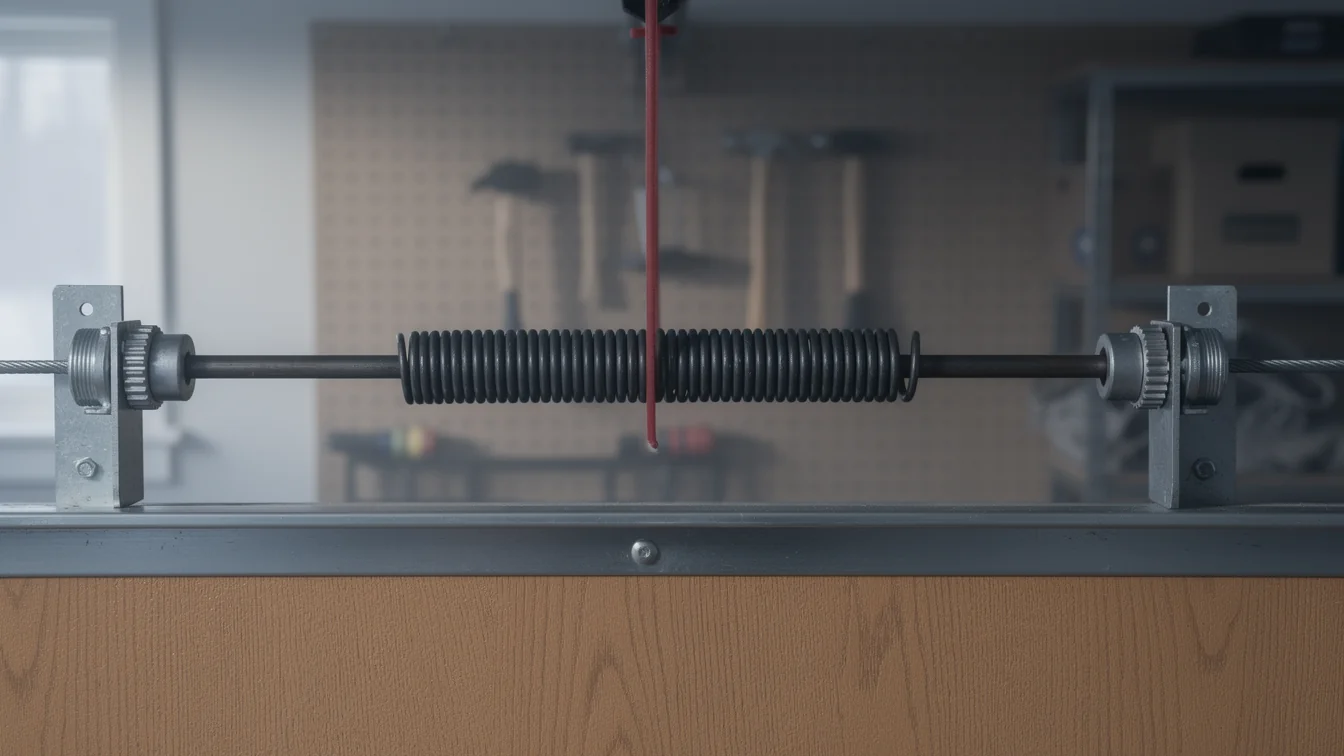
Before you call anyone, look at a few things from inside the garage with the door down. Check whether the springs - the coiled bars above the door, not the cables on the sides - look stretched, gapped, or have a visible separation. A spring that's intact but sagging loose is different from one that's snapped clean; both need attention, but a clean break is the one that means stop using the door now.
Next, check the bottom brackets and rollers for rust or a seized wheel, especially if the door has sat through several winters without lubrication. On houses from the 1960s and 70s stock common across this area, original hardware is often still in place, and steel that's never been greased moves stiffer in the cold, which adds load right when the spring is already working harder. If the door is noticeably heavier to lift by hand than it used to be, that's the spring losing tension, not your imagination. Don't try to adjust or unwind a torsion spring yourself - it's under enough force to cause a real injury, and that's not a job for a Saturday afternoon with the wrong wrench.
What Local Conditions Do
Glen Allen sits in a cold moderate climate band - winters here get cold enough to stiffen steel and shorten a spring's working life, without the deep-freeze stretches that some regions further north deal with every year. That matters for how doors fail: it's less about one brutal night and more about repeated cold mornings adding up on hardware that's already old.
Pair that climate with the housing stock - built mostly between 1938 and 2001, median year around 1974, concentrated in 1960s and 70s construction across the 13 named areas we cover. A lot of those original torsion springs were sized and installed decades ago, and cold weather is simply the trigger that finishes a spring that was already near the end of its cycle count. This is why the failures cluster in the colder months: not because cold breaks good springs, but because cold is what finally breaks worn ones.
The Situation
Across the service area - Lakeside, Dumbarton, Chamberlayne, Innsbrook, Twin Hickory, Ashland, Wyndham, Hanover, Montrose, Manchester, Sandston, Bensley, Bellwood, and Brandermill - there are roughly 44,879 households and about 19,134 owner-occupied houses, a lot of them built in that same mid-century to late-century window. That means a large share of the garage doors out here are running on hardware that's older than the current owner's time in the house.
At a median household income of $67,347, most homeowners we talk to want the repair that makes sense for the door's age, not an automatic full replacement. A straightforward reality: if the door panels and track are in decent shape, a spring swap is usually the right call. If the door itself is from the original 1970s build and the track is bent or the panels are rusted through, putting a new spring on an old door is often good money after bad - that's a case where replacement actually costs less over time.
Frequently asked questions
Why did my spring break overnight instead of while the door was in use?
Springs usually fail at rest, not mid-cycle, because the break point is reached by fatigue over thousands of cycles, and cold mornings are often when a spring near the end of its life finally lets go. It's not about the door being used at that moment - it's the cumulative wear catching up.
Is a broken spring a sign I need a new door, not just a new spring?
Not usually. If your door and track are in decent shape, a spring swap on its own is the normal fix. Replacement only makes sense when the door panels or track are also failing - which is more common on the original 1960s-70s doors still in place on older Glen Allen houses.
Can I just use the garage door opener to force it open?
No. Once a torsion spring is broken, the opener is lifting the full weight of the door with no counterbalance. That will burn out the opener motor and can also pull the door off its track. Leave it closed and unplug the opener until the spring is replaced.
How do I know if it's the spring or just a stiff, cold track?
A stiff track from cold, ungreased rollers still lets you lift the door, just with more effort. A broken spring means the door feels dramatically heavier, sometimes impossible to lift by hand, and you'll often hear a bang at the moment it let go.
Related garage door services in Glen Allen
More garage door guides
Book garage door service in Glen Allen
Call now or request a quote - tell us what the door is doing and where you are.